Wilma Tabacco
  • Home
  • Solo Exhibitions
  • Group Exhibitions
  • Essays
  • Projects
  • Links
  • About
  • Contact
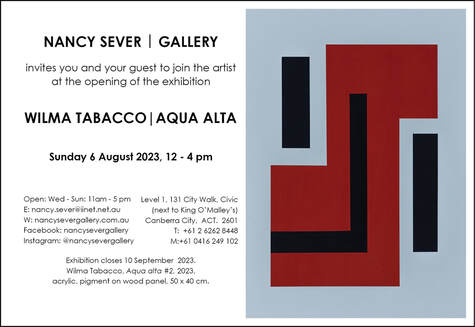
Aqua Alta


Nancy Sever Gallery 
July 30 - September 10, 2023


[View the Exhibition]
​


[Download Catalogue]
​​


Picture
​​

Vittorio didn’t say…
​

Like Jan Morris I too wonder why the monks of St. Jerome monastery in Carpaccio’s painting, ‘…run in comical terror from the mildest of all possible lions;’[1] Vittorio Carpaccio didn’t say - or if he did, his words are now lost and no commentary seems available on the painting St. Jerome and the Lion that, after hundreds of years, still remains as part of a narrative sequence of Carpaccio’s works in the Scuola di San Giorgio degli Schiavoni. The painting depicts a teasingly enigmatic narration that leaves much to the imagination.
 
Jacobus de Voragine in his book Legenda Sanctorum[2] (written in the late 13th century known as Golden Legend) recounts how St. Jerome removed the thorns from a limping lion’s paw and healed the wounds. The monks were terrified of the lion but Jerome treated it like a friend and guest.  
 
Carpaccio’s painted lion looks old, worn out, confused and forlorn. Maybe the wound (or the memory of it) from the thorns is still troubling it or maybe the thorn is yet to be removed and the lion is pleading for St Jerome’s help. This seems likely. Or if they are escaping an ‘off-stage’ catastrophe then it might be begging to go with them –‘wait, I’m coming with you’! The lion in medieval paintings often symbolises prophecy and wisdom. It is also the symbol of Carpaccio’s home: Venice. 
 
The Aqua Alta is loved and hated – out come the gumboots again to wade through the deluge of water. Loved because it clears the canals of refuse but mostly hated because the high tides that bring the Adriatic Sea smashing into the lagoon cause havoc and destruction in the archipelago and the city.
 
It is November 2022 and another of those dreaded inundations arrives to corrode stone, marble, paving, to discolour artworks, to flood piazzas and buildings. The newly completed MOSE (Moses) - barriers between the Adriatic and the Venice lagoon were raised on November 7 and again on November 21 during a storm surge of 185cm, the second highest since the great flood of 1966. The low lying areas around St Mark’s basilica flood at 85cm but the authorities had decided to raise MOSE only when the level reaches 120cm. Transparent glass barriers have now been erected around the basilica: a barrier within a barrier.
 
We are on more solid ground (or are we?) in the Campus Martius (Field of Mars) on ancient Rome’s Palatine Hill. Once military exercise and training ground for the Roman army and place of senatorial elections, it is still there, albeit unrecognisable as the honoured site of Mars, Roman god of war and agriculture. No trace of its original function now exists. Just as there is no, or little physical trace, of the many monasteries perched on so many of the tiny islands in the Venetian lagoon – ruins now, with some of the islands themselves under water.
 
I like to think that Carpaccio’s painting is prophetic: the monks and lion just part of the mass exodus of 70% of the Venetian population over the last 70 years (now at a mere 50,000 from a peak of 367,832 in 1968), fleeing the 30 million visitors who swarmed into the city to trample on their islands, calle and bridges in 2022.
 
I am happy to be able to enjoy Carpaccio’s painting, the fleeing monks, the limping lion, without any words to instruct and direct my understanding. 
 
Wilma Tabacco
June 2023
 
 
[1] J. Morris, Venice, Faber & Faber, 1960, 3rd edition, 1993, p. 220

[2] J de Voragine, The Golden Legend, Latin translation by G. Ryan and H. Ripperger, Arno Press, New York, 1969,      pp. 587-592.

Wilma Tabacco © 2025